
Introduction
Type 3 is not easy to get. It is often confused with tendencies of the American way. While this mindset may be stronger in the United States, it became a growing tendency in the world. This short sentence illustrates how people often imagine type 3:
Enneagram Type Three (the Performer), the ideal of our culture with its projections of boundless health and self-confidence,
Type 3 is indeed self-assured. But I don’t believe it is the origin of these cultural patterns. We could imagine that type 3, by adapting his presentation to his own culture, would be more likely to exhibit such an identification. I don’t believe so.
In more psychological terms, type 3 is sometimes related to an hyperfocus on a precise action which is more likely to be the obsessiveness of the gut center. Since type 3 is accurately called “the doer”, it can be confused with the head center also known as the “doing group”. It makes type 3 difficult to highlight among what looks like it.
Description
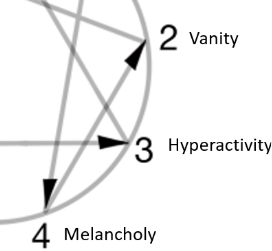
Type 3 is at the center of the living group, also known as the relation instinct. It is the core image type.
Type 2’s lack of self-worth is compensated by inflation as he sees himself an indispensable selfless and loving person. Type 3 is more a chameleonic type. He too follows an impossible quest to be loved for what he does but his lack of self-worth needs to be compensated by an image validated by others. A 3 craves to be loved, valued, and secretly wants his doing to be praised and validated by others. While self-assured, type 3 wears his narcistic wound in the most visible way.
Type 2 nurtures others, represses his desire for validation, and proclaims his value. A 3 instead is dependent on the way his image is received by others. He combines two strategies:
- Focus on efficiency and identify with doing.
- Adapt his self-presentation and become what people like.
The doer
As he perceives what the environment values and desires, type 3 experiences a higher energy for doing. As he starts to identify with doing, he is invaded by narcissistic questions and neediness.
There are at least two ways to misinterpret the “doing” of type 3:
The gut center creates an obsessiveness and a self-forgetful immersion in action. Personal feelings tend to be suspended. It can be routine, an unshakable pace for 9s, it can be perfection and musts for 1s (which can include a certain efficiency motivated by a sentiment about the quality of the work), or it can the blunt obsessiveness of 8s who forcefully remove obstacles.
The head center as the “doing group”, is into practical requirements, which direction to go, opportunities, authority, the decision process, getting things done and telling others how to think or do. While all mind types tend to be mentally confused during action, it does not prevent them from being resourceful and sometimes efficient.
Instead, type 3 is focussed on the efficiency of an action when he feels it is wanted by the environment. Since type 3 is neither a practical (head) type, nor focussed on survival directly (gut type), he is not especially sensitive to what needs to be done through his own instinct. A 3 uses the heart center instead and perceives actions around as a global process. He is motivated by the desires of others rather than personal ones, sensitive to the global flow of doing in the surrounding environment.
Within this global process, a 3 identifies with doing. He is somehow his role, even if “role” must not be understood too much as a societal notion or a predefined plan. His role is more spontaneous and perceived in the flow.
Imagine you find yourself parachuted into a musical band with an instrument in your hand and know how to play it. There is a global flow of doing, producing a result. This is where the energy of a 3 comes from, within the sense of how his own personal doing resonates in the global flow. He is carried by an energy where image concerns arise about his contribution to the music. He is attentive to whether he is going to be appreciated or not. A subconscious craving for love and attention makes him raise above the rest.
This action does not expect a personal gain directly. It is not about something to do because of a practical requirement, which would be the head center. The action for a 3 comes from an external desire, implicitly or explicitly, and becomes a goal to which his self-esteem is attached.
The desire for self-worth invades his mind and becomes the primary feeling. Like for all heart types, shame and worthlessness mutate into neediness and as a 3 immerses in doing, his desire to be loved becomes the only emotional reality. It results in a certain falsity that hides a dark and painful shame. Like a 2 for his good deeds, a 3 barely welcomes compliments about his work. He craves for love and validation, but the irony is that a 3 cannot enjoy the success he has been looking for.
Chameleonic presentation
We could imagine a 3 hides his calculating personality by a fake friendly smile. It is not that. First, a 3 is not calculating the way we could imagine. Rather than this, an extremely lovable personality is an aspect of him.
There is a strange ability in the heart center to perceive the way people see us, the kind of feelings they emit, the values of a human being they desire to see. It happens mostly beyond consciousness and requires few thoughts. It subsequently produces a check of the adequacy of the projected image against these expectations. This does not always lead to adapt. Type 4 can go the other way, justified by an ideal. Type 2 makes himself independent of it. Type 3 adapts.
Just like he invests his energy in doing, a 3 invests his energy in building a personality to be validated, based on the messages he perceives. This does not lead him to change his convictions or beliefs. He just becomes lovable. His built persona has subtle elements of an excess of charm and is slightly counterfeit. But it does not prevent people from liking him.
I like to compare to type 7. A 7 can be a charmer too, sometimes put some emphasis on appearances and his style of success, promote his way and choices to reassure himself. Some people praise him because it corresponds to their own expectations, some dislike him for what it represents.
A 3 finds a compromise of likeability and avoids this pitfall. A 3 does not promote things people dislike. He does not boast around his success (he is neither modest). He does not show a fancy car and a big house without putting the appropriate feelings in it that will make people feel at ease and valued. In a way, a 3 avoids anything that is dislikable. There is something in his presentation and feelings that makes him lovable beyond anything he identifies to. Moreover, type 3, like all approval seekers (3,6,9), is naturally supportive and values the achievements of others.
The obvious consequence of such an adaptative persona is that it is not much related to real desires and plans. A 3 does not have a personality sophisticated enough to hide the gap between his presentation and his actions. They do not match.
Jealousy
Rather than competitive, I would call type 3 jealous. This jealousy is the core of the heart center. It is not wanting materially what people have, like “the grass is greener on the other side”. It is neither a jealousy in the context of a relationship. One role of the heart center is to create connections that ensure our survival and take us as close as possible to the top of the social hierarchy. It is not consciously perceived as such but shows as this deep jealousy.
Type 3 notices painfully the attention other people receive for their actions. The jealousy of the heart center converts the shame of not matching someone’s expectations into the hatred of somebody who does. It sounds like envy, but envy is more like a generalized hatred for the ordinary and a shame of one’s perceived nature. The jealousy of type 3 happens in the context of external expectations and receiving positive praise.
Hatred is a feeling and not much an action designed to harm. I believe a 3 cannot do much with his hatred, except devaluing his competitor by subtle and hidden remarks. It does not hide a sneaky plan; it has no aim, it is not even rivalry. It is just an inner battle about who has value.
There are many styles of jealousies across the Enneagram circle, mainly the 1ish judgmental jealousy, the territorial or paranoid jealousy of mind types… The jealousy of type 3 is in my opinion the most painful internally but the least dangerous. It has almost no practical consequence.
As far as I have seen, success for a 3 is not anything grandiose, it is not wealth, and it is not fame. It is the success at a given action meant to receive praise and validation by someone or the audience. The perceived failure at an action makes him jealous, like if he prepared himself to devalue his competitor and take the shame and self-hatred out of him. It seems that the disintegration to 9 prevents it from happening much externally.
Self-dreaming
There is another aspect of type 3 more related to imagination. Finding solace in the fantasy of a success narcissistically rewarding is often attributed to type 4 but I believe something very similar exists in type 3. It may belong to both types with a different form.
The narcistic wound of 3s is partly compensated by doing, partly by relating and appearing, but also by an internal image of his potential self. It looks like a fantasy of achievement we could have in late childhood: being a rock star, an artist, a worshipped idol, the captain of the ship… Type 3 has a strange tendency to sell himself as this potential self and put it forward, even if he knows consciously it is not reality. It is his most histrionic side, as he asks to be loved for something he knows to be unreal.
Fakeness of feelings
An image type corresponds to the relation instinct. It always involves real feelings but not necessarily sincere feelings. Namely, the feelings of a heart type are to be consistent with the image currently used to relate with someone. It is not like a real friendship or compassion. It does not hide something opposite and malevolent, but it is to be seen as disposable feelings.
Like a 2, a 3 has a strong heart energy but it is important to remember that while it may feel empathetic, it does not come from deeply caring but from an adaptive presentation to please and the desire to reach a goal. Of course, heart types can have true friends and really care like anyone else, but it is not so much an aspect of the heart center itself.
I do believe that the essence of type 3 is love. More generally, I tend to see it as the essence of the heart center. It may not exactly be the same kind of feeling that happens in the pleasing and nurturing presentation of 2s and 3s. Maybe it is the capability to exist as an energy of love when the craving for love is overcome.
Disambiguation
Misconceptions
Reframing failure as partial success: 3s do not talk of their success and even less of their failures. Reframing failure as a partial success is rationalization (7), sometimes just of joke or a way to make people feel better about themselves. It is unrelated to type 3.
Speaking of one’s life as perfect: Type 3 avoids boasting if people dislike it. Type 7 does it as a way of self-reassurance and idealization. Speaking of one’s wonderful job and activities is one style of 7ish storytelling.
3 vs 1
3s and 1s have a lot in common but these types almost cannot be confused. Hesitating between 3 and 1 is most likely caused by being neither, but connected to both (typically 9w1).
Hard work does not help for a disambiguation. 1s are not always focussed on a personal ideal, they have a large degree of compliance to external expectations. 3s do not personally care about honesty, but they are not especially dishonest either. 1s care a lot about honesty but they can be dishonest (hypocritical).
1s are friendly and respectful, but not as warm as 3s. Essentially, 1s are visibly angry, serious and more rigid as opposed to the lovable adaptive and slightly counterfeit persona of 3s. When it happens, the excellence of 3s seems to come smoothly from a mysterious place and is not like the “trying hard” energy of 1s.
This video by Dr. Tom about type 1 may be very useful to see type 1 in the context of working: I am type 1?.
3 vs 7
Type 3 is the doer of the heart triad, noticeably good at practical know-how. The head center is the “doing group”: resourceful, into practical requirements and action.
Since 5s and 6s do not have the pleasing persona and positive presentation of 3s, the only type of the head center that resembles type 3 is type 7. The similitude is bluffing to a point I still cannot see the difference in some cases. Some 7s do not look like 3s, but when they do, it is puzzling. I called this style of 7 the “promoter”.
“Talking a lot of what you do” is not type 3. One thing that is typical of 7s is a certain kind of propaganda about what is cool, not cool, and things to do to get there. It must be emphasised that all mind types share the fear they lack abilities to do things. When overcompensated in speech as self-reassurance, this can be mistaken for type 3.
Another aspect that makes 7s sound like 3s is the inferior / superior dichotomy. 7s always have a “worse than / better than” comparing speech at the back of their mind. It may sound either like 3ish jealousy or 4ish elitism. Like 3s, 7s tend to attract positive attention and to be the center of the show. We can say that 7s are into more excess of grandiosity, but it is not always the case. 3s and 7s are mostly indistinguishable about it. 3’s hyperactivity can be confused with the fast impatience of 7s: I want to get there, when do we get there? Putting his own action at the center, and requiring others to work as much, a 3 can work others to death but 7ish gluttonous authority can have the same effect.
As a key reminder: type 7 is the clearest narcissist of the Enneagram (even if average 7s are not narcissistic). 3ish narcissism is more subtle and less aggressive.
3 vs 9
Since 3 is the security point of 9, 9s are somehow 3s in disguise. There is maybe nothing of type 3 a 9 does not have. They may have mostly the positive aspects of it but I guess a closer look will reveal some neurotic patterns of 3s as well. The traits of type 3 exist in 9s, hidden and transformed by 9’s unassuming and disillusioned surface.
3s are much less angry than 9s but since 9’s anger can sometimes be invisible and unconscious (not always though), it does not always help to see the difference. Many differences could be cited, but it may be more important, when considering a 3-like 9, to look at the 9 patterns, which may require advanced knowledge of type 9: the behavior of type 9 is far from straightforward. Typically, the “over non-conformist” aspect of type 9 is at odds with 3, but it is not easy at all to describe.
The heart center connects to others, esp. at 3. The question of the heart center is “Who I am with?”. All heart types are quite aware of other’s persona and motivations. I would say that the kind of connection a 9 is expecting is more total and deeper than a heart type, while he is less conscious of the other’s motives.
To give a few examples, Bill Clinton, Barrack Obama… are 3-like 9w1s. The lies of a politician are not only a compulsive ego pattern, it is a conscious strategic decision and an inbuilt talent at keeping a smooth self-confident surface whatever happens.
If you take the list of best tennis players of all times, at least the twenty firsts are 9w1s. Their extreme competitiveness is a matter of temperament and comes as much from 9/1 as 3. And of course talent which is not a type. It’s just a very small sample. There are more 3-like 9s than 3s.
Notes
Type 3 is one of the types I understand the least. There may be some elements missing from the text.
I insisted mostly on the image aspect (appearing, neediness and jealousy) as they are the ones I could see the best. People sometimes describe type 3 as “driven” or “ambitious”. What is sure is that these terms are too broad to capture type 3. If there was something specific about type 3 about it, I would not be able to describe it very well.
One aspect often mentioned about type 3 is a tendency to detach from one’s feelings or natural creativity in order to do. I did not include it because it seems common to too many types.
The falsity of type 3 is mostly an affective one. The deceit is about personal motivations. I don’t see 3s deceitful about facts.
Resources
- Dr. Tom: I am type 3?
- Ichazo’s short description: Unveiling the Enneagram – Arica 3
 Enneagram Elements