
- Introduction
- Anger, resentment, perfectionism
- Core 1 vs connection to 1
- Note about “American gothic”
- Resources
Introduction

Type 1 is maybe the easiest to understand. It is a building block of the western culture: the crusader scared of his own fallibility. So many of us teach and preach, want to fight injustices, oppose truth to lies, believe the Law or the “system” is outrageously imperfect or dream of a perfect Law.
The white knight turns red when his belly gets hot against a blatant wrongdoing and looks like an 8, standing fiercely in his rage, ready to give the world a better shape. His wrath will make it right. At night, when the doubts come in, all the small mistakes and deviation from a straight line come back to haunt him. His fierce criticism turns against him. He is unloved.
The obvious reality of type 1 should be a first warning that the Enneagram is real. Type 1 has the extraordinary quality to not deny itself. It is not hidden. Like any type, its surface form varies but this cold interiorized rage turning every muscle into a block of concrete is unmistakable.
Even if our type is not fully determined, it is often possible to observe how resentment and anger works. The key functioning of the passion is shared by any person having a connection to type 1 as a wing (9w1 or 2w1) or as an arrow (4 or 7). Due to a strong disproportion in the prevalence of types, most of us are connected to type 1.
Anger, resentment, perfectionism
The passion of type 1 is an emotion we all know: anger.
Type 1’s anger is mostly interiorized and controlled so that it could be called irritation, annoyance, or frustration. Markers of a repressed anger can be a tension in the arms, in the jaws, and for a self-preservation 1 a constant anxiety and physical discomfort. This anger is related to the gap between “what should be” and “what is”. “What should be” is a deeply idealized conception of the world as it is meant to be (virtuous, moral, orderly, logical, good, pure, benevolent…) as opposed to the actual world.
What we desire as perfection varies from the proper position of objects in a room to moral principles. We can imagine a few themes:
- intellectual: truth, accuracy, large scale moral issues
- personal: personal ideals, heartfelt intentions, loyalty
- quality: practical perfection in works, forms and arts
- behaviour: responsibility, good manners, acceptable behaviour
Type 1’s anger tends to be compulsive and justified by a mental discourse like criticism or judgement. It can lead to an action, a change, an improvement but it may just be resentment. Resentment can be an everlasting grudge against someone or a flaw, or a bitter indignation at having been treated unfairly. Since anger is considered as a “bad” emotion and 1s avoid being bad, their anger grows until their superego allows to act out of it.
A person having a strong judgemental eye for imperfection needs to embody what he considers as perfection. A typical 1 tends to be self-controlled, with a strong inner critic and some physical rigidity. 1s tend to have qualities aligned with their notion of perfection: morally principled, high-quality standards, responsible… Criticism from someone else may be the straw that breaks the camel’s back and 1s can be surprisingly touchy. Judging people can lead to a certain form of heartlessness.
When resentment turns into an obsessive tunnel vision against some enemy (a person or an idea), a 1 can lose sight of the most basic requirements of morals and honesty. He can reach the point of becoming blind to his own offenses and feed his anger by imaginary offenses from others. This happens mostly for unhealthy 1s or 1s in great stress and can be confused with type 6 (paranoia, projection), type 7 (bad faith, mythomania) or type 8 (denial, vengeance).
Perfectionism forbids taking a step into the morally grey zones of life where irrationality and unacceptable impulses need to be experienced, or when tricks are more efficient than truths. But it is hard to deny the qualities of a person who genuinely struggles for perfection: honesty, respect, doing nothing wrong, loyalty, accuracy… In our noisy and deceptive world, recalling our sentiments is invigorating.
Core 1 vs connection to 1
Because of its relative simplicity, type 1 can often be observed before our core type.
Seeing type 1 is especially useful for 9w1s. 9s have a huge difficulty seeing their type. It is hidden to them. 9s may sometimes realize their behaviour matches type 9 but from an inner perspective, type 9 does not seem to exist. It feels like a fog rather than anything with a shape.
Any type can have 1ish qualities but 1s have a few specific traits. In a word, 1s are simple.
Nothing about them is hidden. What they decide to invest in life is made of one consistent block. To understand what it means, we can compare to type 9: a 9 agrees at the surface and then becomes avoidant. Instead, a (sufficiently healthy) 1 who agrees really agrees. There is no mixed signal, no hidden message, no secondary option, no subconscious B plan… Moreover, 1s do not see these things in others. 1s have a rather light presence and others can feel their alignment almost physically. An opinion they express is entirely what they believe, not a maybe, a wish or a whim.
A 1 is self-critical but not to the point of considering the inner critic as a problem. He is aligned with his “must and should”. When inner demands exceed what is possible, a 1 drops them. It would be imperfect to indulge in impossible expectations. As a consequence, it is not difficult at all for a core 1 to say “no”. A 1 does not sound externally like blaming himself beyond what is reasonable. The main defence mechanism is “isolation”. At the surface and in usual manifestations, it consists in accepting the critic that is manageable but discard a larger picture.
This should help to tell a core 1 apart from the withdrawn types connected to 1. For 4s and 9s, the inner self-image can accept a larger amount of self-depreciation. A counter-intuitive fact about 1s is that they are usually genuinely joyful unlike the more depressive 4s and 9s.
Note about “American gothic”
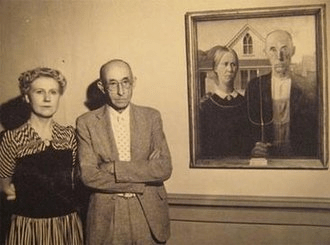
The painting is a very realistic picture of two persons. These persons are probably not 1w9s but 9w1s. The painting evokes the stoicity and self-control of 1s with a certain tone of rigidity and “squareness”. But what we see on the picture looks more like the placidity of type 9, combined with a secondary 1ish vibe: austerity, serious, annoyance. Real 1s look slightly more present at the surface and their anger is more tangible.
Resources
- Ecletic energies : Energy and the Enneagram
- Dr Tom: Am I type 1?
- Recommended authors : Eli Jaxon Bear, Helen Palmer
 Enneagram Elements