
Introduction
Enneagram type 5 has remained quite mysterious for me over the years, while my perception of the other types improved.
I live in a world considered as a 5’s one. During my studies (pure mathematics), I was surrounded by people with unusual intellectual abilities. Some of them (researchers) are still my friends. Many of us share a certain discomfort with practical life, we are not prone to any excessive display of feelings, we live in our head, we have interests in technical or intellectual matters. But is it related to type 5?
Let’s see type 5 as a Bigfoot, a rumour says it exists. Let’s try to imagine the Bigfoot but let’s be prudent, it is possible that on our way to find the Bigfoot we encounter something else.
Type 5 and abstract knowledge
According to Ichazo, the mind centre is ruled by the question: “Where am I?”. Based on a rough understanding of types 6 and 7, we can see it as a radar picking up information about the environment to detect threats and opportunities, act accordingly and fast enough to deal with it and create alliances. It corresponds to Ichazo’s “adaptation instinct”, our capability to adapt to any practical situation dynamically and use the most of it for ourselves and others. The mind centre is also related to the cohesion of the peer group (siblings, classmates, co-workers…). Spending time with our peers is no guarantee of being a mind type, the mind centre is meant to have an influence and give the group a direction (authority).
Reading a book about physics, computer science or psychology is most often not related to such a radar. Our relationship to formal knowledge involves curiosity about the world, about human nature, about ourselves, professional requirements, the need for order and structure in our mind, a taste for categories and formal truths… It is not always practical and if you think of it, abstract knowledge does not help to create alliances more than any other activity such as soccer or bodybuilding. A scientific discovery has a long-term effect on the scientific community, but it may not correspond to a direct drive to influence the peer group or get anything from it. There seems to be no clear relationship between formal knowledge and the mind centre.
5’s avarice can be interpreted as a desire to fill an anxious sense of inner emptiness with observation. By comparison, 7s fill the terrifying silence around them by their liveliness, plans or anecdotes. The defensive detachment of 5s can be connected to a mental attitude to hold on anxiously to the “clear and evident” to avoid being overwhelmed when mixing with the world and this may lead to a dry intellectual attitude. These two points seem to suggest a connection between type 5 and something cerebral but before assuming it is involved in any scientific activity, solid elements need to be observed.
A knowledge-oriented person would show as a mind type only if what he learns is related to his radar and involves anxiety. Intellectual persons who are also mind types have elaborate defences: 7’s rationalization becomes intellectualization, 6’s reaction to authority involves concepts… But a motivation such as “If I don’t read this book, I won’t have this competence or will get it wrong” is more likely to be type 1: live up to some standard and avoid mistakes.
Even without formal knowledge, the radar of mind types can detect threats, information, and opportunities in the environment. Non knowledge oriented 6w7s and 7w6s are natural people readers, capable to capture trends and information on the fly without a need for formal knowledge. Type 5 should do something like this. But what?
Ichazo’s view of type 5
These short texts available at Ocean moonshine have always proven to be accurate and were for me the most useful tool for understanding the types beyond the usual descriptions.
Point 5 is known as “Ego-Stinginess”. The fixation is also known as “Over-Observer”.
This ego derives from the Practical Ego, which is a response to the Adaptation Instinct. The psychic poison of the Adaptation Instinct at the root of Ego-Stinge is Confusion.
Ego-stinginess experiences a sense of Alienation in the childhood relationship with siblings and/or peers.
The main ego-characteristic of this fixation is Withdrawal. The Passion which feeds this ego is Avarice. […]. Worsening of this fixation can lead to either the Schizoid or Anti-Social Personality Disorder. […]
Becoming fixated in the Domain of Social Interaction, there is a swing to the dichotomies of that domain. This can manifest in a positive sense as Sociability on one side, or Privacy at the other side. It can manifest in a negative sense as Meddling at one extreme or Alienation at the other extreme. These dichotomies are represented by two characters: the Busybody at one end, the Loner at the other. A sense of Hatred invades the consciousness in this domain. The stress of being fixated and imbalanced in this domain can lead to Phobias as a compensatory mechanism. The poison of this domain is Envy.
Many terms are not surprising. We find stinginess / avarice, alienation, schizoid, withdrawal, privacy, loner. The first idea that should attract our attention is the other side of the dichotomy: sociability, busybody, meddling. It clashes with the common idea that 5s are non-intrusive. All dichotomies work as a balance: if one side goes mad, the other goes mad too. The more a 5 would become a loner, the more he would become “meddling”: intruding into others’ business.
5s would be fixated in the domain of social interaction. This is quite surprising. Think of the classical picture of a 5: a person working in a small room on theoretical physics, alone to concentrate on his work. We all agree that 5s may differ significantly from this stereotype, but this withdrawn researcher is still our archetypal 5. Why would a 5 adopt a strategy to avoid the domain he is fixated in? Think of 7s as a comparison. 7s are fixated in the domains of position and authority. They show a strong interest in embodying or promoting authority most of the time. Even if they are not trying to adopt a position of authority with their interlocutor, the conversation often revolves around authority or sounds like a preparation to establish authority. Following the same principle, 5s should be highly focused on social interaction as their primary concern.
We have no precise picture of type 5 yet; we have just gathered elements that seem to clash with the usual descriptions of 5s. Before we go further, we need to explain how these descriptions are influenced by some aspects of type 9. This usually goes unnoticed.
Intellectual 9w1
Explaining the apparent similarities between 5 and 9 is difficult. I do not mean that 9s look like 5s. At the moment, I still don’t know what type 5 is. What I know however is that a certain style of 9 can be seen as a 5.
9 is a member of the withdrawn triad with 4 and 5. While 4 and 5 are cousins, there is a wide variety of patterns associated with 4s that 5s are not supposed to have: emotionally needy, intense, and expressive in relating. 4s are known to be unusually open to the pain of others and attracted by it. Their 5 cousins, while at least as sensitive, would display a dull aloofness, a cold cerebral attitude, impenetrable expressions… 5s would be secretive while 4s would be self-revealing…. This would be enough to tell 4s from 5s and it sounds like the two types are not so difficult to tell apart. What defines 5 instead of envy would be a certain reluctance to give energy, opinions, or belongings.
5s and 9s are harder to tell apart than 4s and 5s. The main point of this section is to suggest that what we imagine to be a 5 is most often a 9w1. This will require an advanced understanding of type 9.
Ichazo’s view of type 9
Point 9 is known as “Ego-indolence”. The fixation is also known as “Over-Nonconformist”.
This ego derives from the Historical Ego, which is a response to the Conservation Instinct. The psychic poison of the Conservation Instinct at the root of Ego-Indolence is Greed.
Ego-indolence experiences a sense of abandonment in the childhood relationship with a Mother figure.
The main ego-characteristic of this fixation is Disillusionment. The Passion which feeds this ego is Laziness (Sloth). [..]. Worsening of this fixation can lead to the Avoidant/Dependent Personality Disorders. […]
Becoming fixated in the Spiritual Domain, there is a swing to the dichotomies of that domain. This can manifest in a positive sense as a focus on Spirituality on one side, or Realism at the other side. It can manifest in a negative sense as Fanaticism at one extreme or Skepticism at the other extreme. These dichotomies are represented by two characters: the Believer at one end, the Doubter at the other. Prejudices invade the consciousness in this domain. The stress of being fixated and imbalanced in this domain can lead to Sensuality as a compensatory mechanism. The poisons of this domain are Ignorance, Arrogance and Stupidity.
Some terms are no surprise: indolence / laziness, greed. Arrogance and prejudices connect to 9’s stubbornness while ignorance reminds of 9’s tendency to be sleepy or sweep problems under the rug.
The believer / doubter dichotomy is often interpreted as the tendency of 9s to avoid decisions, keeping a long-term attitude of reluctance in relationships or groups and a tendency to disengage without fully withdrawing. But Ichazo directly interprets believer / doubter in the context of spirituality and gives these words a spiritual meaning.
The word non-conformist is puzzling. 9w1s are known to be rather conformist: a stable daddy with a stable job who does not rock the boat. But a fine observation of 9s will reveal a subtle indifference for social demands: the way 9s behave show a complacent attitude against the need to interact openly with others. Assuming disillusionment brings a certain critical tone of disappointment to the picture, this non-conformism could be the same as a non-conformism against social beliefs. Ichazo’s definition of “non-conformist” is simply: disagreeing with the world.
Geniuses
It is almost impossible to give a truly convincing proof that scientific geniuses and mystic philosophers are 9s. I am not talking about scientists in general. Scientists of a lower (yet international) calibre can have other types (for example John Conway is a 7). But the focus on geniuses tends to select almost exclusively 9s.
A single case (for example Einstein) would require a long text and an immersion into the person’s character, life events… We can find testimonials describing Einstein as mischievous (a known pattern of SX 9), some people remember a sense of peace and gentleness from his personality. But this does not fully settle the question. I will give more general elements that should attract the reader’s attention.
Here are two simple ideas before we get into the main points:
- Our geniuses are SX because the sexual instinct brings a restless energy, a fire to pursue one’s interests. Science (or philosophy or art) can be one of them.
- The wing is 1: order, structure, accuracy, truth, morals, patience, principles, perfection
Mystics
SX 9 is often called “the mystic” because of an ethereal quality but it goes much further.
I believe a scientific genius is fixated in the spiritual domain. The physicist looks at the cosmos, unconsciously seeking God among the stars or the perfection and absoluteness of natural laws: Newton, Einstein… The mathematician is seeking God in the perfection of arithmetic, geometric, structural, and logical facts: Cantor, Russel, Gödel… The mystic philosopher is seeking God as the source of perfect reason and goodness beyond our ego-driven nature: Descartes, Kant, Spinoza, Schopenhauer… The biologist is seeking God in the origin and magic of life: Darwin… Some of our geniuses are atheists but their dismissal of religion is still an expression of spirituality. The following quote from Einstein illustrates what I mean:
Einstein: “The human mind is not capable of grasping the Universe. We are like a little child entering a huge library. The walls are covered to the ceilings with books in many different tongues. The child knows that someone must have written those books. It does not know who or how. It does not understand the languages in which they are written. The child notes a definite plan in the arrangement of the books, a mysterious order, which it does not comprehend, but only dimly suspects. That, it seems to me, is the attitude of the human mind, even the greatest and most cultured, toward God. We see a universe marvellously arranged, obeying certain laws, but we understand the laws only dimly. Our limited minds cannot grasp the mysterious force that sways the constellations. I am fascinated by Spinoza’s Pantheism. I admire even more his contributions to modern thought. Spinoza is the greatest of modern philosophers, because he is the first philosopher who deals with the soul and the body as one, not as two separate things.”
Nice guys
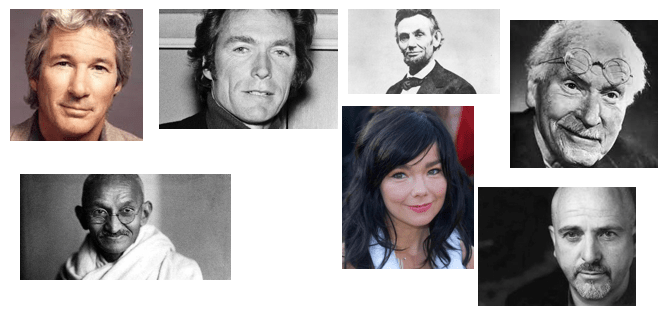
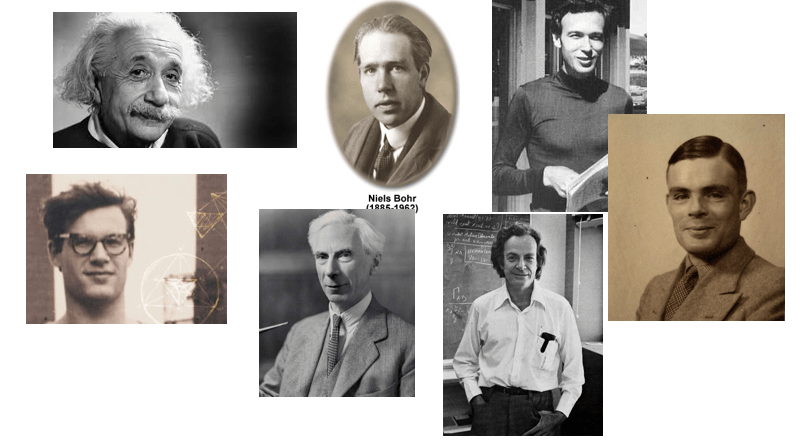
Type 9 is the “nice guy” of the Enneagram. Eli Jaxon Bear uses the word “saint”. A 9w1 is not a saint but it is the first impression we get of him. We can look at photographs. Here are pictures of 9w1s whose type is (almost) a consensus. Look at the energy, the eye expressions, the dreamy and playful sense of niceness, how they are unassuming. And then, compare with some major scientific personalities.
Why 9w1s look like 5s
Here is a brief overview of 9w1 in ten patterns:
- Good natured (9w1)
- Over-apologetic, unassuming (9w1)
- Anti-ego (9w1)
- Feels insignificant in the grand scheme of things (9)
- Non-intrusive, self-effacing (9w1)
- Focused on other’s perspectives (9)
- Self-doubting, self-conscious (9w1)
- Does not rock the boat, goes with the flow (9)
- Universalist, anti-authority (9w1)
- Stubborn (9)
There are many qualities 9w1s have such as being calm, rational, curious, wise, or prudent. It is often said to be the high side of type 5. Many 9w1 and 1w9 are attracted by jobs such as engineer or technical expert. Beyond their personal interest in the field, the enjoy that people leave them alone.
If you get accustomed to see sloth, stubbornness, passive resistance of 9s, you should soon ask yourself: where does a reluctance to get along with people’s expectations or to express oneself come from? Is it sloth, resistance, 9’s sense of personal insignificance and conflict avoidance, a search for external peace by isolation? Or is it 5’s stinginess and detachment? Could arrogance be just a form of 9’s stubbornness? Somehow, you cannot see the difference at the surface easily since the two motives lead to a form of silence and secret.
The key differentiator between 5 and 9 would be the radar. 9s have a sleepy radar. A 9 may not easily see that he does not see. 9w1s do not see consciously much of the social dynamics around them and dislike their own criticism of it. Their radar is somehow deeper and drives their behaviour beyond the conscious mind. They may understand theoretical physics, the external radar directed to the social environment is sleepy, only seeing the best in others or general facts about human nature. 9s capture some elements of the personality of others but do not focus on the practical implications.
What is type 5?
What do we know for the moment? Type 5 is not abstract knowledge. Type 5 is not rationality and Gods of reason. Type 5 is not nonconformist beliefs. Type 5 is not reading books and solving equations. Type 5 is not working alone in a quiet room on quantum physics. Type 5 is not observation of atoms, stars, or animals. Type 5 is not idiosyncratic interests. So… what is it?
Admitting our geniuses and mystics are 9s, what we perceive as cold logic, as a faith in reason vs. the irrational or emotional part of the mind, as a faith in Indian philosophy/asceticism vs. the western way of life… all these dichotomies are likely to be related the believer / doubter. In some cases, they are cultural boundaries. When extreme or absolute, 9s beliefs become alienating, an avoidance of life and can involve paranoid-like oddities (Cantor, Gödel, Grothendieck…). But we are still far away from type 5.
I know what type 5 is falsely associated to. Now, it comes to say what type 5 is. In a word, I have no bloody clue.
Me?
My type is 4. For 12 years, I admitted I was most likely 4w5. I always had a doubt. Writing this text and a few other elements made me doubt it even more seriously.
In terms of MBTI, I am a clear INTP. I used to analyse the mysterious symmetries of numbers when I was a kid. I studied model theory (theoretical logics in connection to algebraic geometry), wrote a few research articles in machine learning. Then I learnt a good deal of quantum mechanics in my free time. Everything I’ve explained in this text is enough to untie such things from type 5. In such topics, I have worked with 7s, 9s, and even a 6. No 5.
After this awful bit of self-promotion, there may be more reasons to suspect I have a 3 wing. For the rest, I will invoke the 5th amendment and refrain from testifying against myself. More seriously, everything I could write would be more confusing than useful. I don’t really know for the moment.
Type 5 as the DOI of type 7
One possibility is to see how type 5 would be the driving force behind type 7. Here, I am giving an unhealthy picture to make it “scream”.
When flowing towards type 7, the withdrawn power seeking of 5s would become territorial and observation would serve as the source for gossip, reframing, intellectualizing a hasty perception of social reality, creating unreal connections between ideas and promoting them to the external world. This line from 5 to 7 could produce interpersonal paranoia and rivalry. The cowardly alliances of “those who know” would become self-serving, keeping the public eye outside of the castle of the smart kids. The peer group would keep the sheep out there occupied with fake information but without a grip on the decisions. This would somehow be the castle that the envious little observing 5 could not enter. In unhealthy 7s, this goes further: alienated delusions, narcissism and pulsion to impose one’s dreamed superiority by the destruction of others. The arrow from 5 to 7 may explain much of the ordinary paranoia around secret services, conspiracy theories, sects, and real criminal mafias.
Now, I’ll just talk of something closer to me. I worked with 7s and managed a few of them. I can feel they are more relaxed and cleverer when they observe rather than rush. For an average to healthy 7, the integration to type 5 works a bit as follows. An enthusiastic 7w6 may meet some resistance when trying to communicate, make the authority flow, get the actions done (w6). He may experience a frustration or a sense of injustice that could dangerously lead to a disintegration to type 1. A 7 may be right about his sense of injustice but the line from 7 to 1 is a practical dead end. If you claim to be the victim; this is unlikely to improve the situation.
Instead, you must calm down, observe, collect information: what is going on, how do such or such social interaction work. Where is the best advisor or ally? Can you do something or nothing? Sometimes, you may stop here: nothing is possible, but your understanding of social realities becomes richer. The observing skills of a 7 calming down become powerful, the opportunities appear, the 7 knows how to act with what strategy. The doors open. For a heathy 7, it serves the peer group. It reinforces its cohesion and good mood.
 Enneagram Elements